Development of Virtual Thermal Sensor based on Multivariate Time Series Prediction for Estimating Internal Contact Temperature of High-Voltage Relays
##plugins.themes.bootstrap3.article.main##
##plugins.themes.bootstrap3.article.sidebar##
 https://orcid.org/0009-0006-8252-5346
Jaephil Park
Sanghoon Lee
Abstract
In power electric (PE) systems of electric vehicles (xEVs), the function of switching power between the battery and inverter is essential for safe operation. This function is performed by the Power Relay Assembly (PRA), which consists of two high-voltage relays (HV relays) that connect the battery’s positive terminals and continuously conduct high current during driving. Unlike low-voltage relays, HV relays are designed with arc-suppression structures and timing control to minimize arc damage, resulting in relatively rare arc erosion failures. However, the passage of high current through the contact interface generates significant heat, leading to material degradation and structural deformation, which have been identified as major failure modes. Such failures can cause abnormal open or short circuits in the high-voltage system, potentially resulting in loss of power control or fires—posing critical safety risks. Therefore, early diagnosis of these failures is essential. HV relays have a sealed design without dedicated cooling, causing heat to accumulate internally under high-current conditions. For effective failure diagnosis, internal thermal monitoring is crucial. However, due to constraints such as limited design space, the need to maintain airtightness, and cost considerations, the number of sensors that can be installed for relay state monitoring is severely limited. As a result, accurately capturing the internal terminal temperature, which is a critical indicator of failure risk, remains challenging. This study proposes the development of a multivariate time-series prediction-based Virtual Thermal Sensor (VTS) [1, 2] model capable of estimating the internal terminal temperature of HV relays using only limited external sensing data available in actual vehicles—such as relay voltage, current, and ambient temperatures. Because the internal temperature evolution depends both on past history and current operating conditions, a Bidirectional Long Short-Term Memory (Bi-LSTM) [3, 4] network was employed to effectively capture these dependencies.diagnostics and remaining useful life (RUL) prediction of high-voltage relays. Future work will focus on refining the VTS model for improved accuracy and reduced computational complexity, supporting the development of practical RUL prediction systems for HV relays.
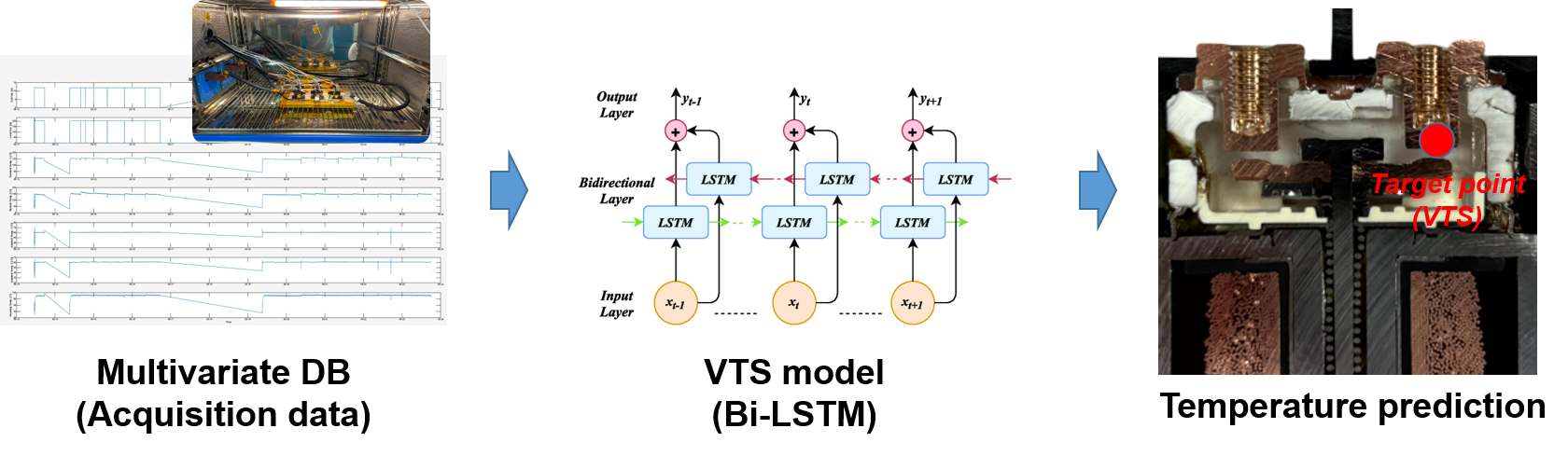
For model training and validation, datasets were collected through high-temperature accelerated life tests of HV relays. The dataset includes time-series measurements of ambient temperature, relay surface temperature, bus-bar temperature, operating voltage, and load current, along with specially instrumented measurements of internal terminal temperature for ground truth validation. To improve prediction accuracy, key influencing variables were selected through correlation analysis, and advanced data preprocessing steps were applied to handle irregular cycles, long-term trends, and saturation regions—ensuring the data’s suitability for modeling. Up to 50% of the total dataset will be reserved for validation, with prediction accuracy to be statistically assessed using metrics such as Root Mean Squared Error (RMSE). This research provides a foundational technology for indirectly estimating the internal terminal temperature—an otherwise difficult-to-measure parameter—enabling degradation diagnostics and remaining useful life (RUL) prediction of high-voltage relays. Future work will focus on refining the VTS model for improved accuracy and reduced computational complexity, supporting the development of practical RUL prediction systems for HV relays.
##plugins.themes.bootstrap3.article.details##
Virtual Thermal Sensor, High-Voltage Relay, nternal Temperature Estimation, Multivariate Time Series Prediction, Bi-LSTM
Ahn, C.-U., S. Oh, H.-S. Kim, D. I. Park, and J.-G. Kim. 2022. “Virtual Thermal Sensor for Real-Time Monitoring of Electronic Packages in a Totally Enclosed System.” IEEE Access 10: 50589–600. https://doi.org/10.1109/ACCESS.2022.3174287.
Bai, S., J. Z. Kolter, and V. Koltun. 2018. “An Empirical Evaluation of Generic Convolutional and Recurrent Networks for Sequence Modeling.” arXiv Preprint arXiv:1803.01271. https://arxiv.org/abs/1803.01271.
Liu, J., D. Yang, K. Zhang, H. Gao, and J. Li. 2023. “Anomaly and Change Point Detection for Time Series with Concept Drift.” World Wide Web 26: 3229–52. https://doi.org/10.1007/s11280-023-01181-z.
Shin, S., B. Ko, and H. So. 2022. “Noncontact Thermal Mapping Method Based on Local Temperature Data Using Deep Neural Network Regression.” International Journal of Heat and Mass Transfer 183: 122236. https://doi.org/10.1016/j.ijheatmasstransfer.2021.122236.
Silva, D. 2022. “Modeling the Transient Response of Thermal Circuits.” Applied Sciences 12 (24): 12555. https://doi.org/10.3390/app122412555.
van den Oord, A., S. Dieleman, H. Zen, et al. 2016. “WaveNet: A Generative Model for Raw Audio.” arXiv Preprint arXiv:1609.03499. https://arxiv.org/abs/1609.03499.
van Overschee, P., and B. de Moor. 1993. “N4SID: Numerical Algorithms for State Space Subspace System Identification.” IFAC Proceedings Volumes 26 (2, Part 5): 55–58. https://doi.org/10.1016/S1474-6670(17)48221-8
Yu, F., and V. Koltun. 2016. “Multi-Scale Context Aggregation by Dilated Convolutions.” arXiv Preprint arXiv:1511.07122. https://arxiv.org/abs/1511.07122.